
Making sense of Makerfield
Some constituency polling on how people voted, why and what happens next.
One of the greatest things about British politics is the way in which the grand and significant are kept in check by the local and parochial. Entire political careers are born and extinguished under strip lighting in leisure centres at 4am.
So it was that in the early hours of this morning, at a local music venue in Wigan, standing next to a man with a bin for a face, Andy Burnham delivered one of the most seismic by-election results in British political history. An increased majority of 9,231 votes - and a path to potentially becoming Prime Minister – produced by a 20+ point win over Reform in a race that was supposed to be close.
More than anything, it is an abysmal result for Nigel Farage’s party in target seat number 29 for them. But it is a lot more besides.
So how did it happen, and how should we understand it? Through the last week or so, Persuasion had some polling in the field in Makerfield with Convergent Opinion. Conducted both face-to-face and online this polling turned out to be the most accurate in the race, much to the credit of Fintan Smith and Dylan Spielman who run Convergent. And it gives us some priceless insight on what was going on under the surface.
1. Andy Burnham has a genuinely unique connection with voters in Greater Manchester
Though Makerfield has always been Labour, on current national polling it simply should not be. This was a 65% Leave seat in 2016. With Reform sweeping the local elections in May, all national trends suggested a comfortable pick-up for them.
The singular reason it was not is Andy Burnham. Robert Kenyon was a flawed opponent, but no more so than most put up by Reform. Burnham’s share looked more like his totals when running for Greater Manchester Mayor in 2024 than anything predictable through party brands - something which Survation’s Damian Lyons thinks may itself be at the root of why pollsters under-estimated him.
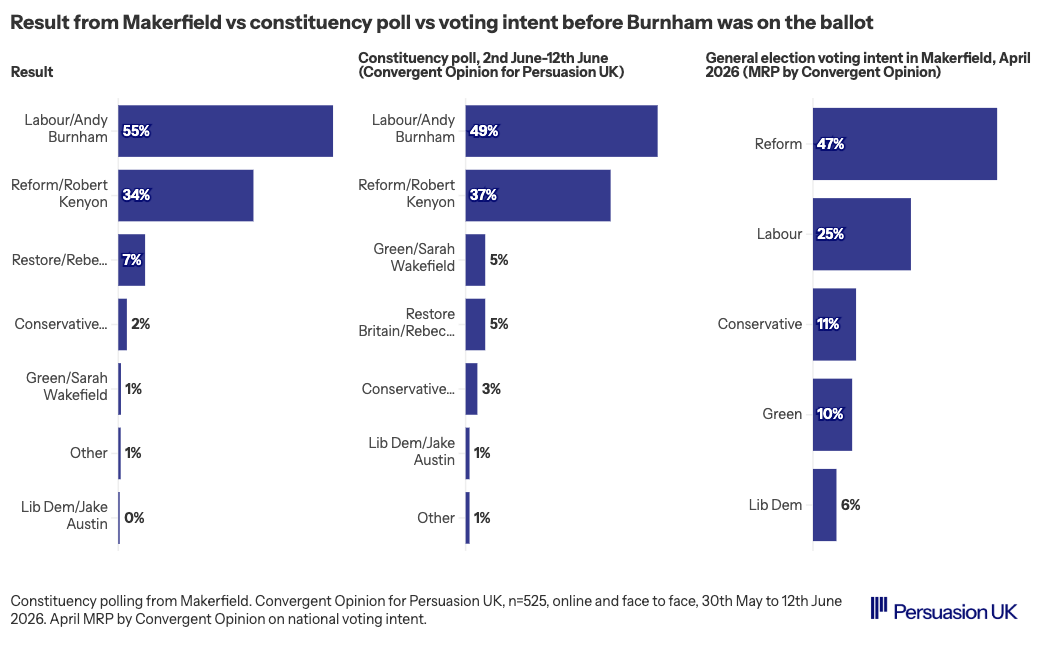
2. Burnham is assembling a coalition in Makerfield that looks like the one Labour needs to win the next general election
To win a majority next time, the boring truth is that Labour needs to do two things: unite progressive voters behind them in the right places AND pull over some vote from the right (2024 Conservative or 2024 Reform) to offset Labour-to-Reform switchers. For all the electoral wreckage of the past two years, Persuasion’s research has consistently shown this coalition to still, just about, be in reach for the government. Beneath the surface, yes; disaffected and dispersed – but never totally adrift.
This is precisely what we saw with Andy Burnham in Makerfield.
In our polling, he was retaining 81% of Labour’s 2024 vote, where nationally Labour is keeping under half. He brought back into the fold voters who elsewhere have gone Green and Lib Dem or else stayed at home. That big chunk of Labour 2024 voters who tell national pollsters ‘don’t know’ and then get taken out of the sample - back in the tent.
And then, in the final days of the campaign, something our polling was maybe too early to capture, he swallowed up what was left of the Green and Lib Dem vote, with both parties smartly leaving him a run at it.
This masterclass in bloc efficiency was topped off by 8% of the 2024 Conservative vote and 5% of the 2024 Reform vote defecting to Labour. The first of these – soft Con 24 voters open to voting Labour to stop Reform – remain under-studied but potentially vital in a ton of constituencies at the next election. The 5% clawed over from Reform were vital for partially offsetting the 11% of Labour voters lost to Reform in the other direction, a fraction Burnham did not actually improve on over Starmer but instead replaced.
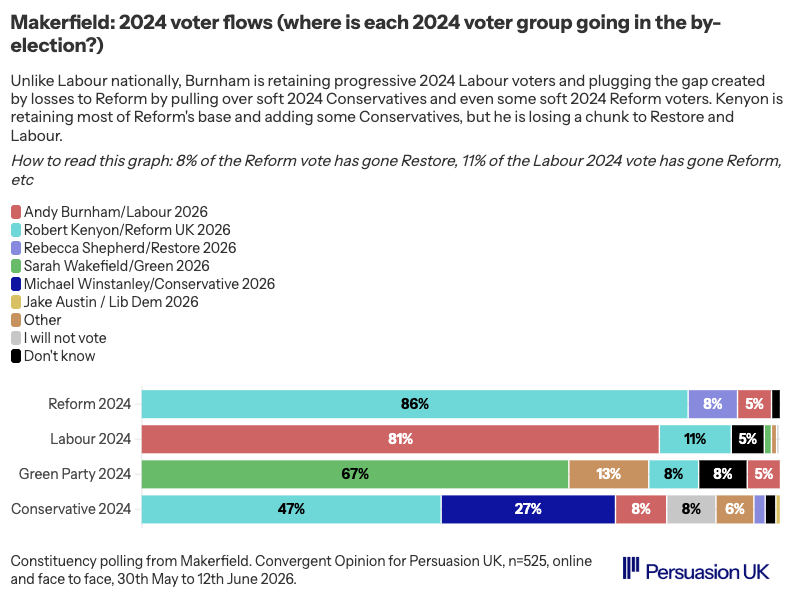
We also found limited hostility to Burnham among Restore voters, the even more radical right party in the contest, which may have been part of why Reform found them hard to squeeze. Many of those voters are, to put it mildly, not aligned with Labour enough to vote for them - but they didn’t mind if Burnham won. In this sense, Burnham was more or less the perfect candidate: energising his own bloc, pulling people over, but never being polarising enough to unify the other side’s base. Broadly, we see similar trends in his national polling - at least for now.
3. Burnham’s vote was drawn to him by two things: national change and a bold message on the economy and public ownership
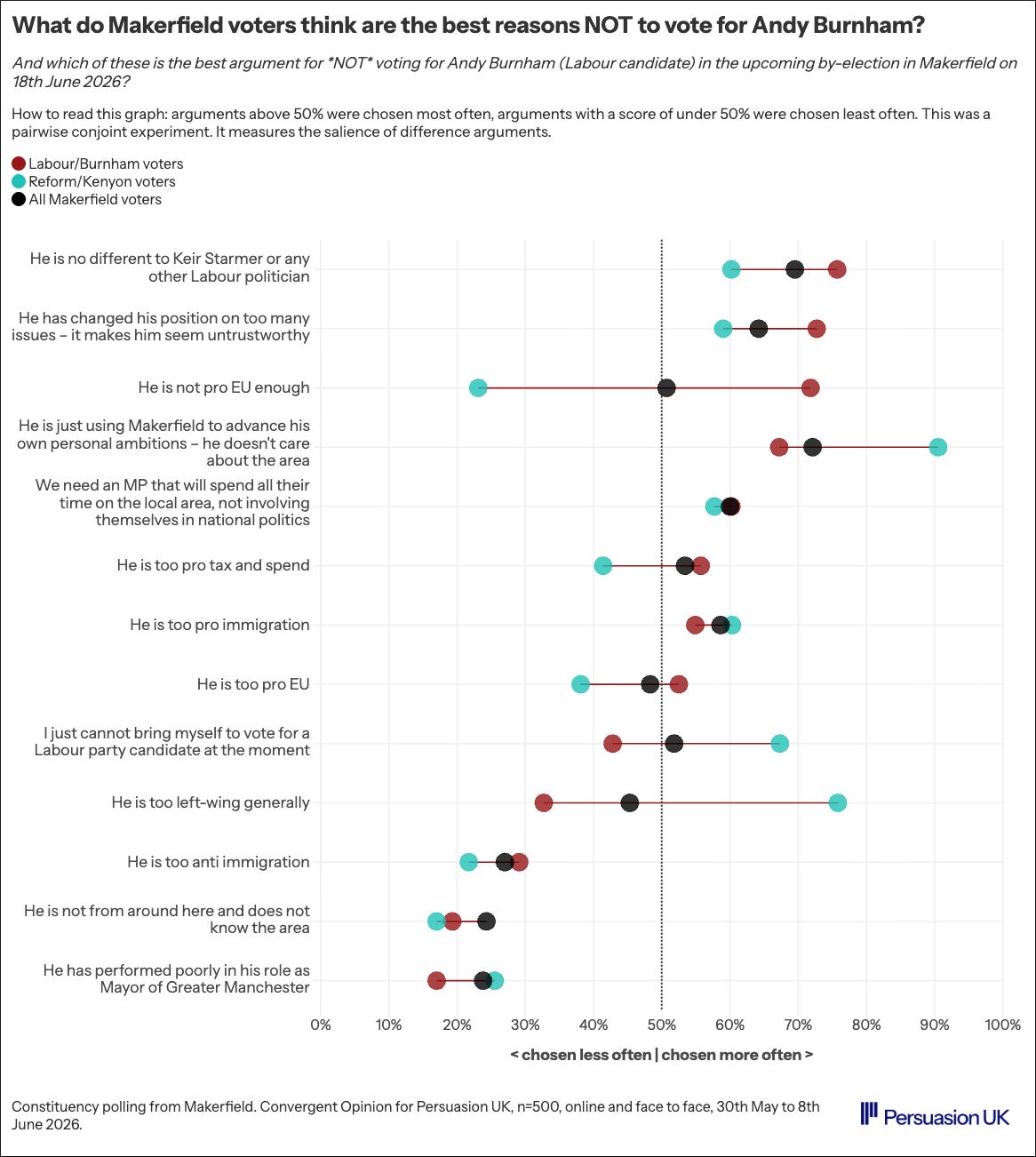
As part of our polling, we did what was called a pairwise conjoint experiment: we drew up a long list of pro and anti Burnham arguments, showed people a few random pairs and asked them which they found most convincing. It’s a good way of measuring the salience of different candidate strengths and weaknesses.
What we found was striking. The arguments for him that most consistently won out were two-fold. For voters overall, as brutal as it sounds, it was simply the prospect of Keir Starmer being replaced as Prime Minister.
Among Burnham’s voters specifically, this was also true. But there was one even more potent adhesive: Burnham’s platform of public ownership and control of the essentials (transport, water, energy).
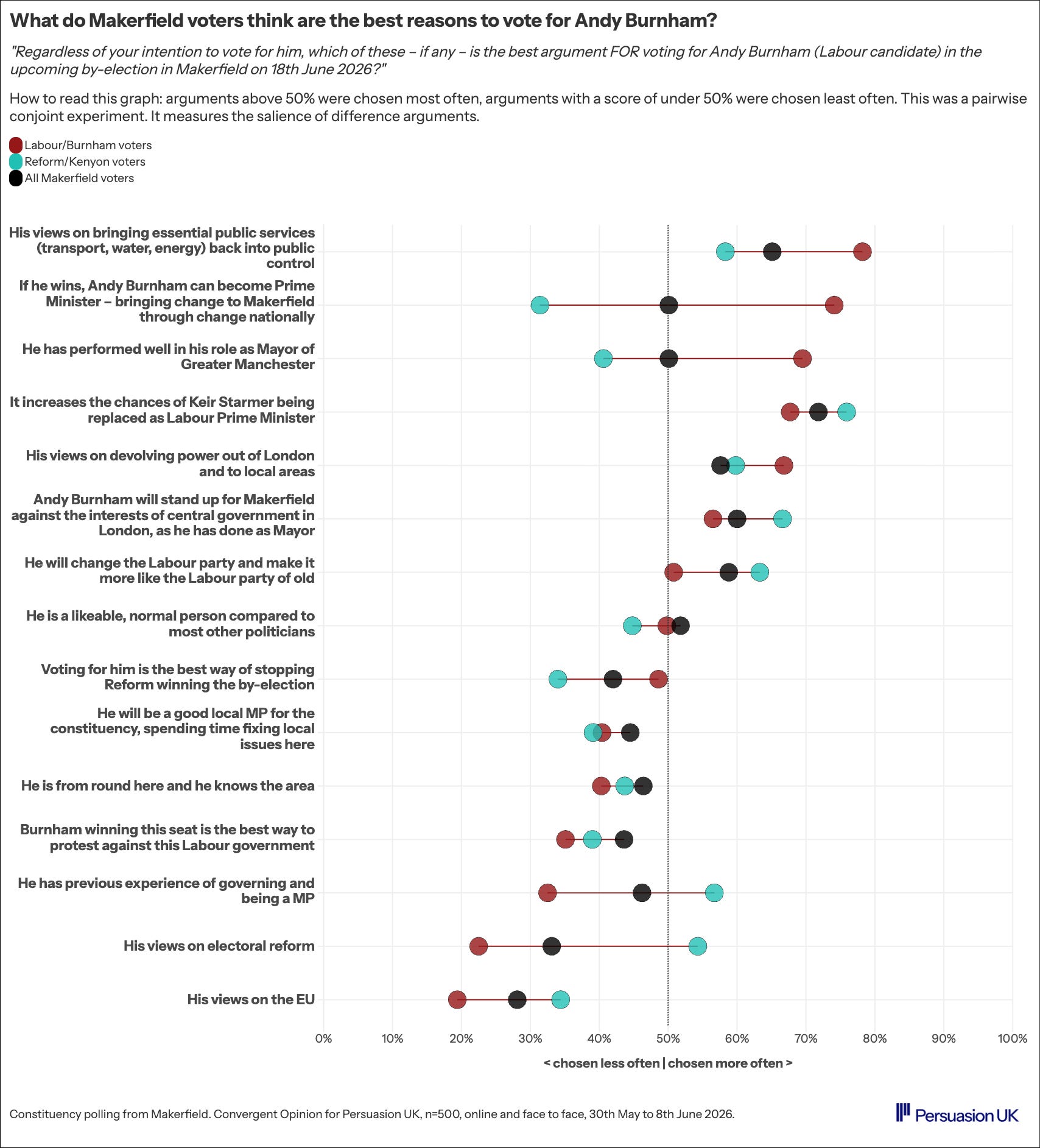
I am not an economist – I have no idea if this is deliverable or desirable (though many fine people say so). But it does speak to a theme I see in every bit of public opinion work I do across dozens of topics ranging from migration to energy to food and Net Zero and big tech: the desperate desire for control. For government to make people feel a bit less powerless and exposed the forces and interests that relentlessly buffet their lives, whether they be faceless and global or closer to home.
It’s also powerful because it speaks to affordability and cost of living concerns. As I’ve written before, leaning into the emotionalism (not just deliverism) of this area – seeking to dominate the attentional space with it in place of cultural divides – is one of the few strategies open to Labour in glueing its vote together.
In this sense, how real or superficial Burnham’s pledges on this turn out to be will go a long way to defining his premiership if he does make it to Number 10.
If we are to take anything from a night in which the Conservatives can be simultaneously reduced to rubble in Makerfield while triumphing in Aberdeen, and Labour the reverse, it’s that voters are not ‘fragmented’ as the argot has it. They are promiscuous, polyamorous even. They are open to any number of parties at a given time and will pick up one and toss another aside as quickly as they decide it useful for whatever purpose is most important to them at a given time.
But if there’s one thing we’ve consistently seen – in 2016, 2019, 2024 – it’s that they are willing to hammer the big red button marked ‘change’ and gamble on those politicians who credibly represent it. We’ve also seen, though, they are just as quick to judge and abandon those who misunderstand the mandate delivered to them.
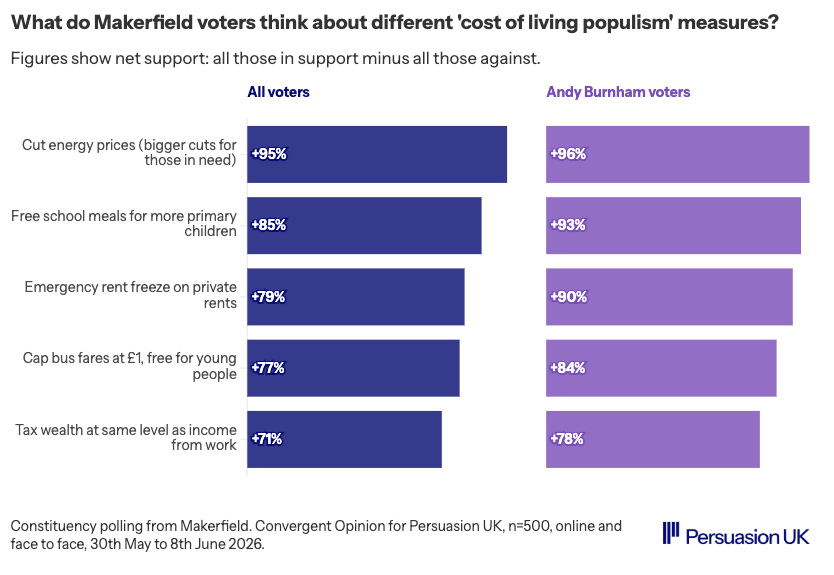
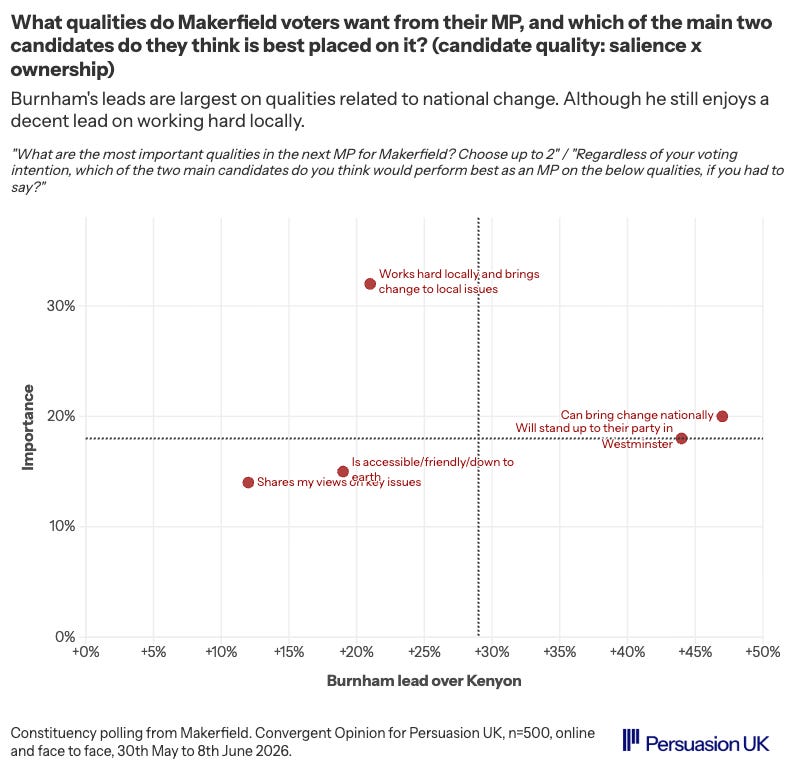
4. In this sense, the biggest doubts among Burnham’s coalition in Makerfield relate to whether he genuinely does represent change.
In the end, ‘He is only using Makerfield as a stepping stone’ was a message that only really landed outside of Burnham’s coalition. This is because, as we saw in the previous section, Labour voters are not idiots – they understood perfectly well what was going on and they liked it. In this sense, I was a bit confused by how pre-occupied Burnham’s campaign seemed at neutralising it.
When we look at what actually gave his voters pause for thought – and therefore better targets for Reform – it was about how different he really is to Starmer. And, relatedly, his alleged flip-flopping.
For all that, when we read out Burnham’s recent bits of ‘repositioning’ to voters – on trans rights, Brexit and immigration – we found there to be no sign that it hurt him (in fact, by a small margin, there were more people, including Labour voters, who said these shifts gave them a more favourable impression of Burnham than a negative one). For some it will be because they brought him closer to their view, for others he has just built up enough of a bank of credit – something Starmer never had much of with progressive voters especially.
There remains a tension there for Burnham, though - between fleeing to the median position on a topic but not whittling down a reputation for authenticity or honesty that is core to his appeal.
There is the bones of something special there.
Indeed, if he does make it to Number 10, he will earn Labour something vital: a second look from voters. But how he uses that brief window of attention will define him. If, when they glance his way, it is equally chaotic and placid, with none of the same insurgency or impatience or antagonism that has defined him, they will look away again pretty quickly.
In my view, what has bedevilled the Starmer project is incoherence: not merely incoherence within policy and electoral strategy, but a lack of coherence between those two things - the hardest but most essential quality to any successful project I think. ‘A better communicator’ will only mask something similar for so long.
Key to all that is working out quickly where the real limits of what can be done are, and where they are being artificially imposed.
If there is though something genuinely distinct and solid about Burnhamism – a ‘there there’ – the next election is wide open.
5. Finally, a quick word on Reform
I didn’t want to end this without saying something more on Reform. At the time of writing, they are still eight points up in the national polling averages (26%) and doing pretty well in council elections.
But this is yet another legislative election where they fell short of expectations and polling national and local. Just as in Caerphilly, Gorton, Runcorn even, the entire Senedd elections.
The reason is simple: a certain portion of the population is turning out and doing anything it takes to stop them winning power.
Reform has made their contempt for liberal England pretty clear - and the feeling is mutual.
Knocking doors over the last few weeks, party activists of all kinds will have met liberal England quite a few times. In the nice-but-not-posh lower middle class suburbs of Makerfield, tidy looking semi-detached houses and neat gardens. The voters found there may not be impeccably progressive on every issue, but they have a quiet decency to them. A revulsion at the way they perceive Reform as inciting race wars or mimicing the worst aspects of Trumpism; for the way their local candidate talked about women.
Much of SW1 cannot get their head around the fact these kinds of voters exist outside of Surrey or Soho, but they do - yes, even in Leave voting seats. They are what so much of this country looks like and they are the bedrock of modern social democratic parties.
If Reform cannot climb above 30-32% of the vote, I am convinced these voters will kill them at the election. Whatever their past allegiances, they have consistently shown themselves willing to mould and coalesce around whoever looks best placed to stop Reform.
Crucial to this co-ordination will be whether Labour can pull clear of the Greens and be the unambiguous (and, crucially, not toxic) anti-Reform option locally. Plus whether the Greens decide to retrench and target their resources in the seats they can realistically win off Labour in the way the Lib Dems retreated geographically in 2024.
Should he arrive in No 10, Burnham possibly makes all of that easier. This is just one of the ways in which Makerfield – and all of the meaning contained within it - is very bad news for Farage.
~ @SteveAkehurst / steveakehurst.bsky.social
Really useful and rapid analysis Steve, the quiet decency voters are a fascinating group to consider. I will inevitably ask if there was any insights on how climate, environment or net zero played out in Makerfield and what that mean if you managed to capture it?