
Understanding Labour's 'revolt on the left'
Who are progressive defectors, who are they not and what influences them?
Pretty much all successful political folklore is simplified to some extent or another. It’s almost an act of Darwinism that it has its edges shaven down, so as to pass more sleekly from generation to generation.
Still, it was always true that the story of how Labour came to win the 2024 general election was too narrow.
For those unfavourable to the party, it was the split on the right. For Labour itself, it was vindication: a relentless focus on ‘hero voters’, Conservative switchers, eschewing left-liberal indulgences to reposition the party as one of moderation and competence.
But this was only ever half the picture. The other half, left mostly unspoken about, was massive bloc efficiency; left-liberal swing voters collapsing into Labour’s column anywhere and everywhere it looked like they could beat the Tories (or going Lib Dem where they couldn’t). For all the mythology that Labour had transcended the need for grads and Remainers – the active disdain for them in some quarters - they formed a bigger part of their winning coalition than ever before.
It’s partly in this blind spot that things have unravelled, with the Gorton and Denton byelection likely foreshadowing May’s elections. The government is now bleeding more to the left than the right in every corner of the country.
But who are these voters switching from Labour to the Greens, Plaid, SNP or the Lib Dems? I have a new report out today via Persuasion, partnering with 38 Degrees, that takes a closer look. I was on the recent New Statesman podcast to chat about it and there’s lots of depth in the full research - including MRPs - but below is a summary.
Here, there and everywhere
Straight out of the blocks, it’s worth taking progressive defection seriously not just as a phenomenon of big urban citadels, or safe Labour seats full of metro libs, but of marginal constituencies across the country. As we see below, defections to the left outnumber right in Labour-Con marginals - and then especially in Wales.
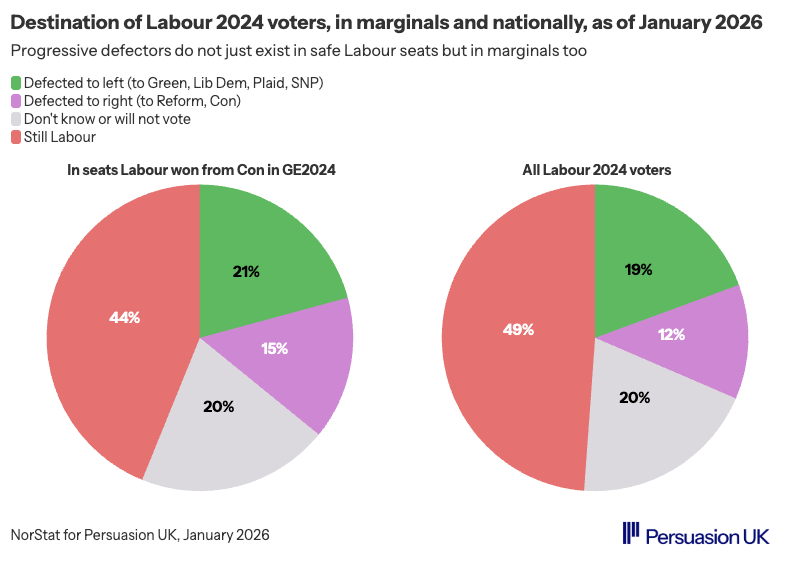
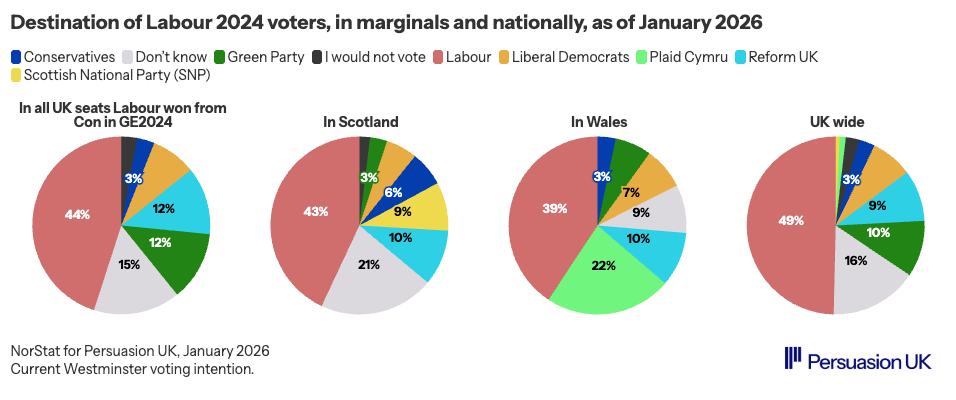
There is nuance here, in fairness, and it’s important to not get too carried away. It is just factually true, as No 10 strategists would remind us, that in Labour vs Conservative or Reform seats – which make up most of the government’s majority – switchers to the right ‘count twice’, since they are one off the government’s column and one onto their direct opponents’ (a six pointer in football terms!). This is why you cannot be too cavalier about those sorts of swing voters, even if they are small in number.
But there’s a few counter-points to that objection, also.
Firstly, there are still at least a hundred odd seats where the government is formally defending itself from another left party – the Greens, SNP, Plaid or Gaza Independents – and that isn’t counting places like Gorton where one of those parties could plausibly challenge from third. It’s progressives who count twice in those places.
Secondly, even in many Labour vs Reform or Conservative marginals, the party is now losing so many votes to the left that they outnumber defectors to the right by more than two to one, hurdling their strategic importance. When you look at these constituencies, as well as Wales you find a lot of them are fast-changing commuter-belt seats of England (what I originally termed as Blue Wall back in 2021). Altrincham and Sale West, Banbury, Truro and Falmouth, Worthing. Here more than anywhere, Labour’s victory owed a lot to squeezing liberal minded voters pushed out of nearby cities.
Finally, the ceiling of defections to the left is just a lot higher, as we can see below – with the potential for far further slippage still.
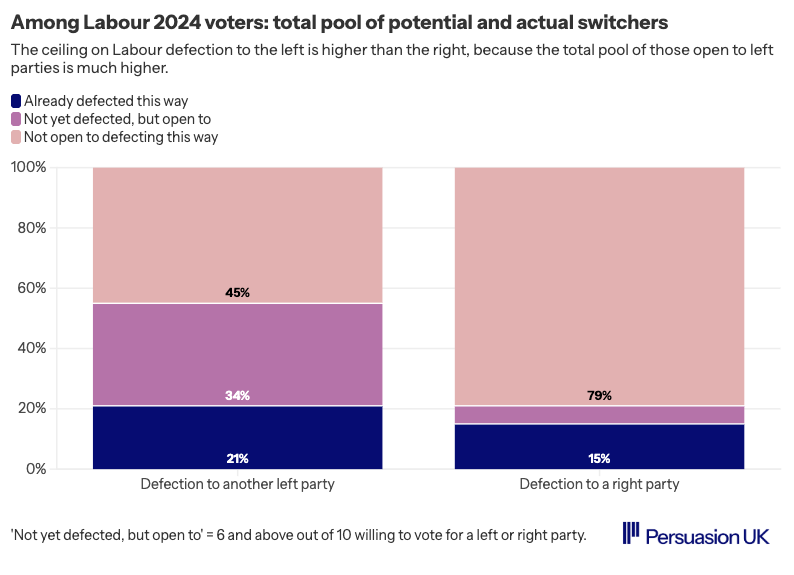
All told, there’s about 138 Labour-held seats with progressive defectors as the most strategically important voter group – with potential for many more.
All of this is a function of the changing sociology of the UK electorate and social democratic electoral coalitions, both of which have more liberal minded graduates than before. This is the vote the party has, even if it’s not the one that in its heart it really wants.
Who are progressive defectors, and who are they not?
The second myth worth dispensing with is the idea of these voters as primarily what Lord Glasman would call a ‘lanyard class’ – an affluent, PMC urban elite with luxury beliefs and big houses.
For the most part, as you can see in the over-indexes below, we’re actually mostly talking about frustrated lower middle class graduates. Notably more female, Millennial, recent home owners trying to pay a mortgage that has shot up in cost, or else stuck renting. Teachers, IT administrators, social workers.
Neither is this phenomenon explained by ‘The Muslim Vote’, despite some of the more sinister media overtones post-Gorton. Even if Labour’s drift with some ethnic minority voters deepens their problems in some seats, nationally at least progressive defectors are even whiter than the country at large.
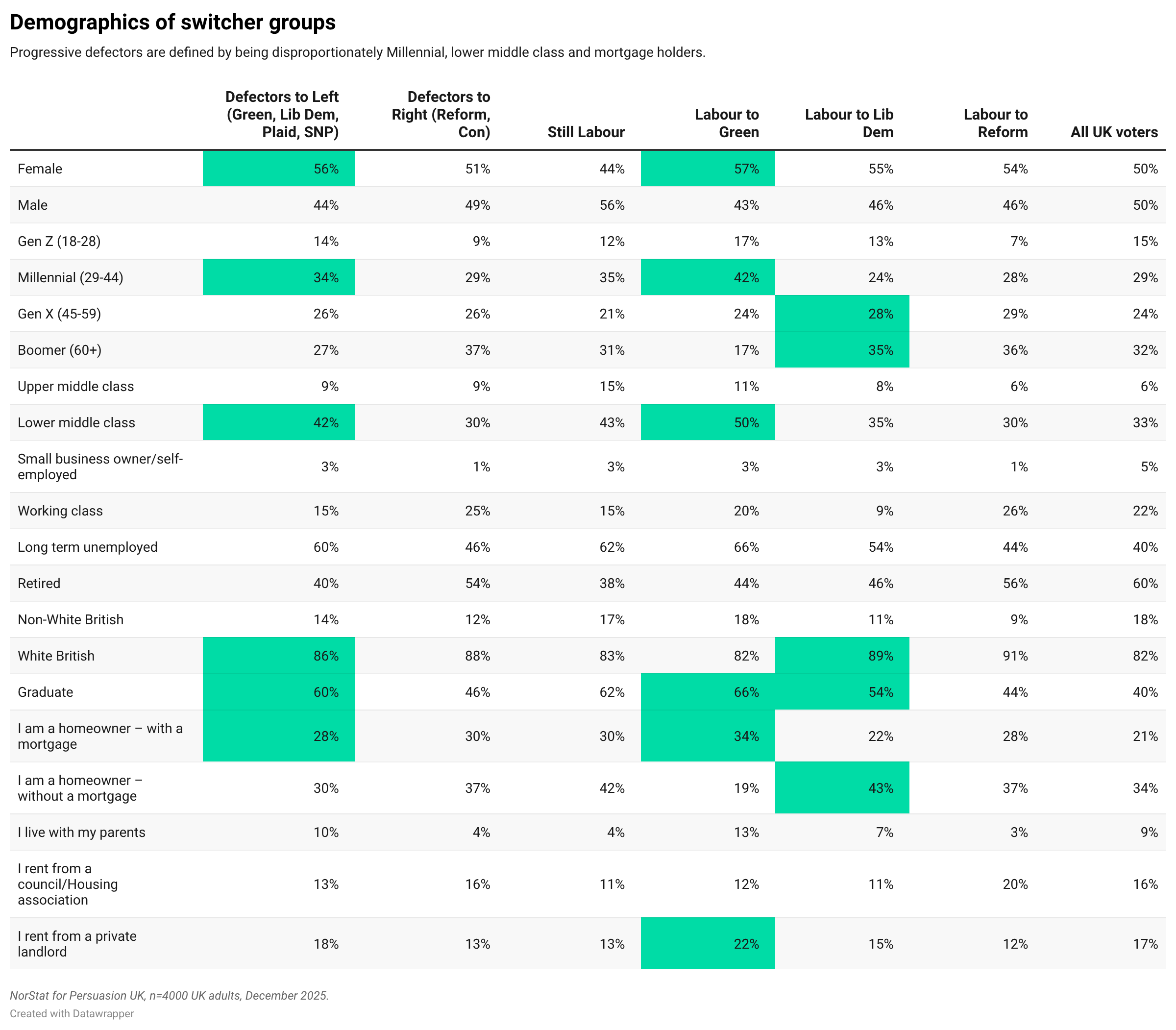
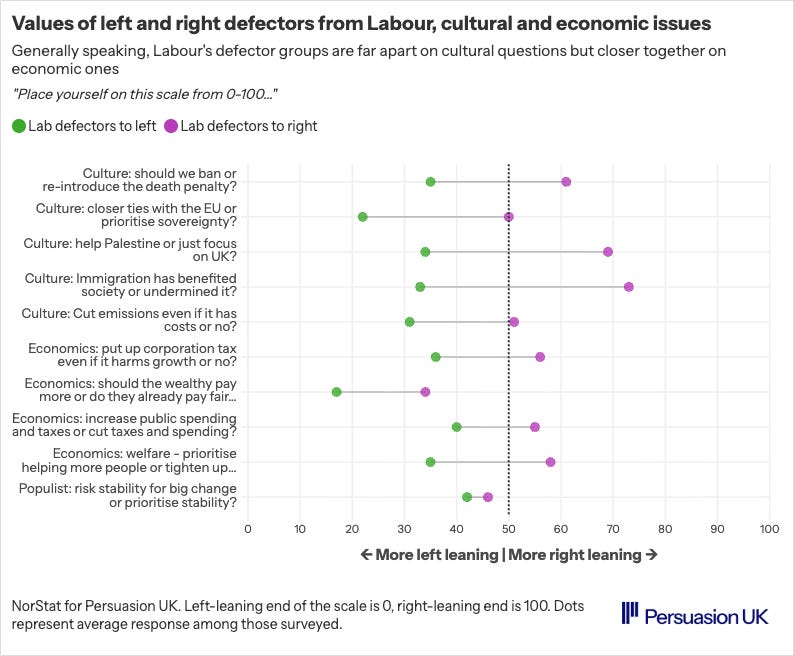
All of which points to a fairly normie affair. As does their values. As we see below, they are decidedly left of centre, for sure. But they are not far left – that vote deserted the party long before 2024. These are bog standard social democrats. Westminster needs to find mental space for this kind of voter which exists in the vast chasm between ‘Red Wall white van man’ and ‘raging Corbynite’, apparently the only two psephological thumbnails available to a lot of lobby journalism.
Why have they defected?
When you start to dig into progressive disaffection, you find both the banal and the novel. On the one hand, similar frustrations to other defector groups – restlessness at the slow pace of change, a ‘gestures to everything’ national ennui. Their values just mean they go shopping for alternatives in a different aisle to their Reform curious equivalents.
But there is also a really striking values component to their irritation. They are far more likely to say the government has the wrong values, not just that it’s incompetent – in short, that it’s more right wing than they expected it to be. This is not refracted through any one issue in particular but a bunch of them.
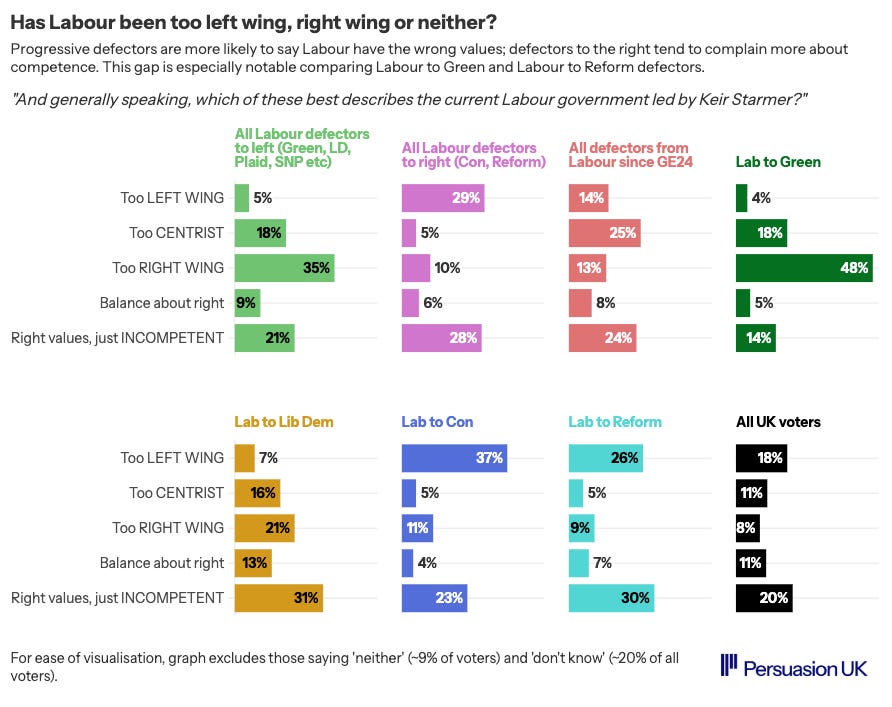
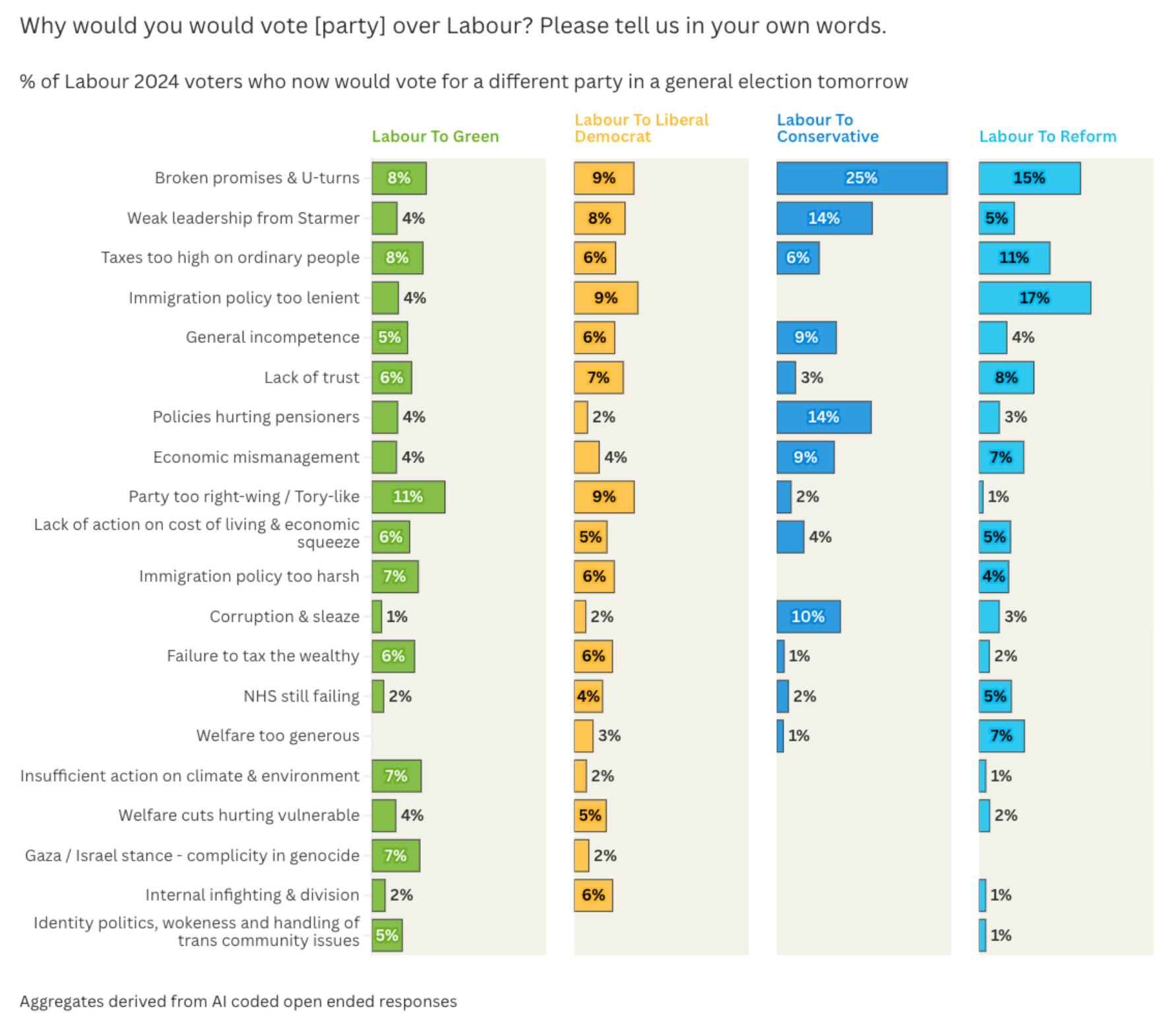
In some areas, you can make sense of this as more than just vibes – it’s plausible they’ve spent a year watching their Instagram feed fill up with backlash to the harsher edges of the government’s positioning on Gaza or asylum (whoever thought it big and clever to brief that jewelry story really needs firing into the sun).
But what’s striking is it extends to economics, too. A plurality of these voters have come to believe Labour to be pro-austerity. It’s not my job to defend government here but, if you stack up the weight of its decision making, that is just bollocks. They have pretty consistently taxed the rich, strengthened workers and tenants rights, increased capital spending, and so on.
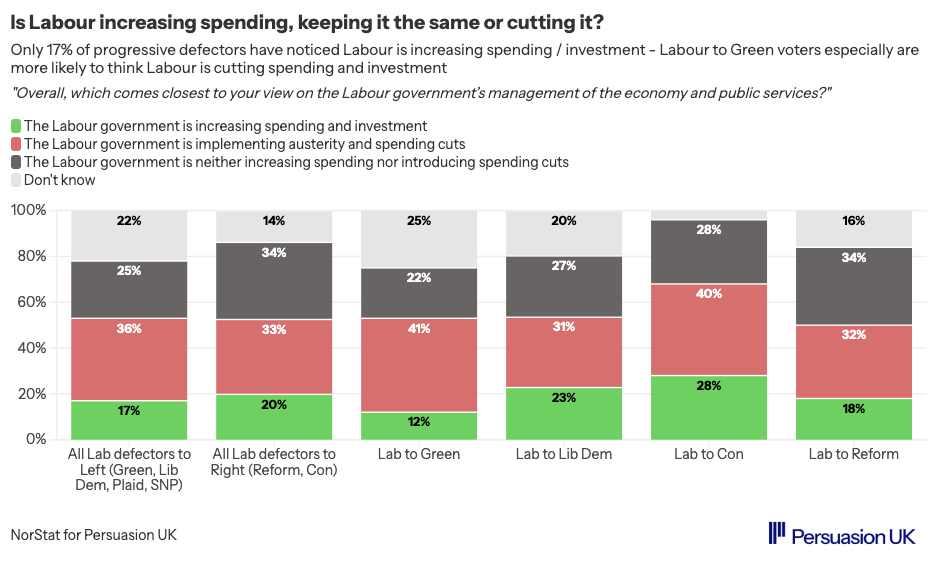
What’s going on here then? There’s a few possibilities. It could be these policies just don’t move people that much in reality, even if they like them.
But it’s also plausible, more so in my view, that it’s about attention. Fights over welfare cuts or the winter fuel allowance have cut through far more – and shaped attitudes more - because they attracted a lot of conflict.
Indeed, until recently that has been an active act of government communications strategy. A desire to downplay progressive things they’ve done – or at least to not sell or seek conflict on them on those times – and foreground the counter-intuitive, ‘not old Labour’ bits of its agenda. There’s a whole other Substack in this alone, sitting as it does at the intersection of Old Right political playbook, Treasury stakeholder management and internal balances of power. But the result is a weird dissonance that’s basically pleased nobody, not least business groups who have happened to notice massive regulatory changes in their areas of interest thanks very much.
Might tactical voting bring them back?
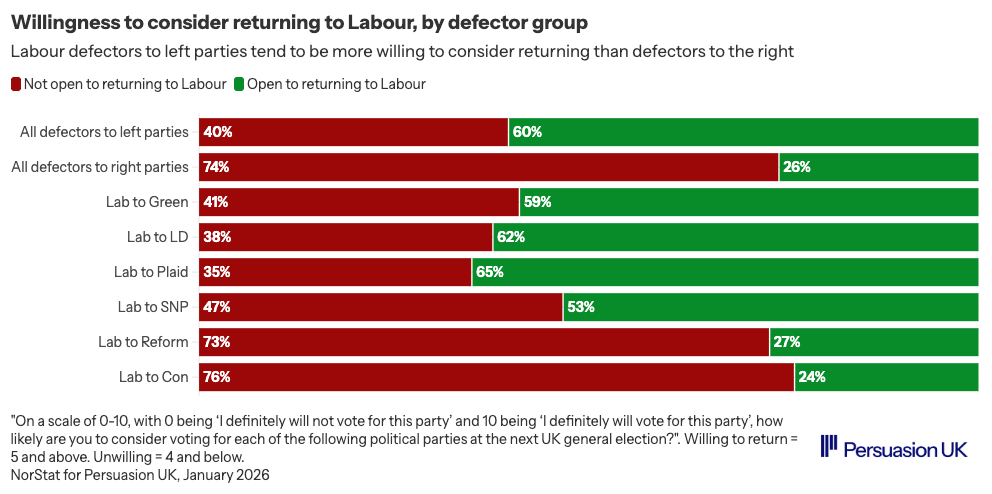
The good news for government is that progressive defectors have not totally written Labour off. To a surprising extent, unlike many Labour/Reform switchers - most of whom look pretty gone at this point - a majority of these voters still remain sympathetic to the government’s inheritance and are open to returning in theory.
But it’s unlikely that tactical voting alone will do this. Up until recently at least, there was a belief in No 10 that “they may hate us, but they hate Farage more” – they’ll come home when they see the whites of Reform’s eyes.
But this argument has always been buttressed by crude squeeze polling – ‘imagine it’s Labour or Reform in your area’ – that increasingly doesn’t reflect the actual information environment many voters will find themselves in. One more hidden price of left bleed is that suddenly progressive voters are bombarded with multiple competing and credible sounding claims to be the best anti-Reform option locally.
Once you put left swing voters in this kind of information environment, as we did in one of the report’s experiments, the natural rate of return to Labour in a Labour vs Reform marginals plummets – even further in genuine three or four ways. This is exactly what we saw in Greater Manchester last week.
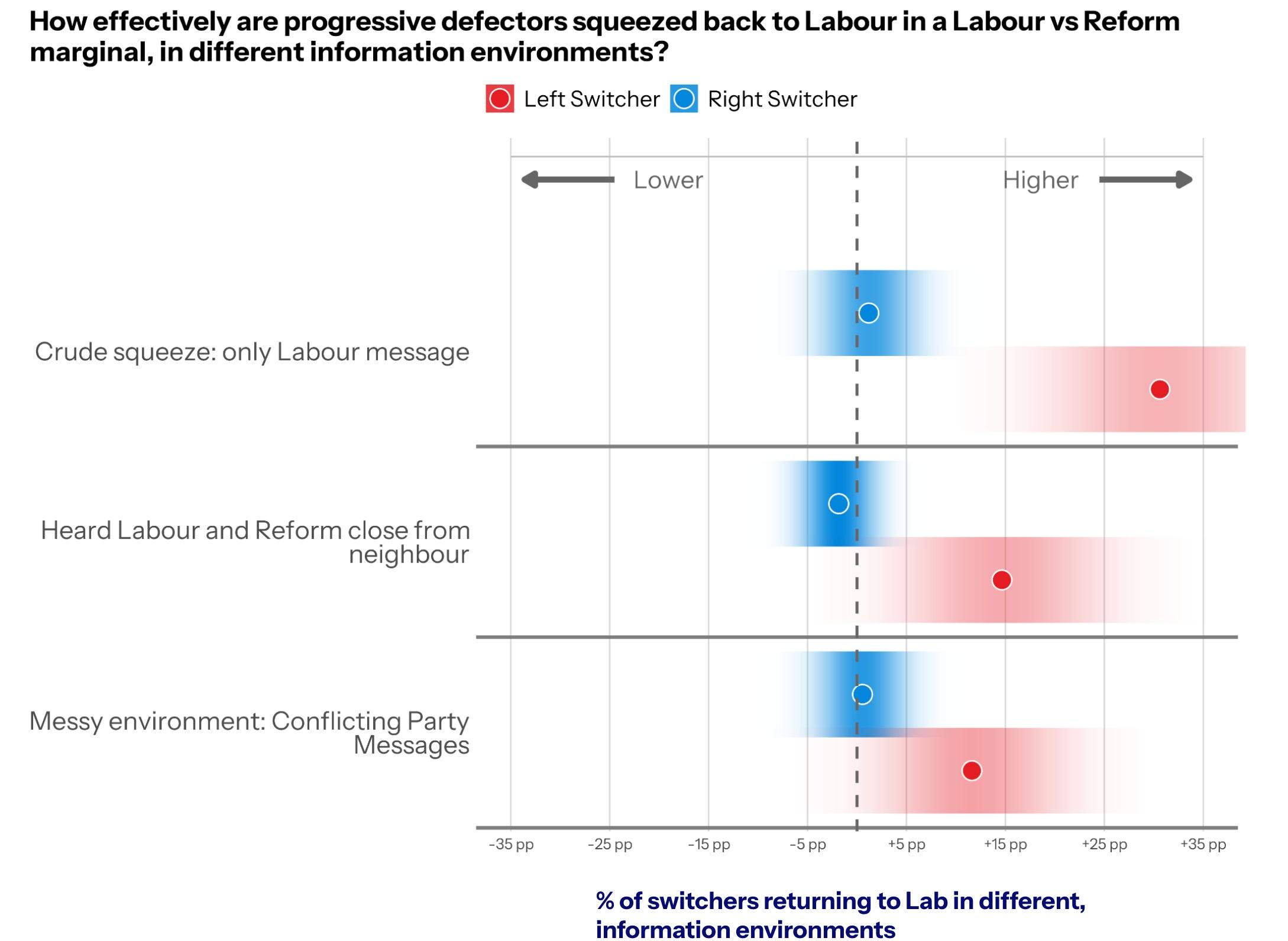
Simply put, when you look at these voters past vote and current considerations, they are genuine swing voters and should be courted as such by everyone – not treated as temporarily grumpy Labour base voters throwing their toys out the pram.
A theory on re-building a viable Labour electoral coalition
Having pulled apart the government’s coalition for the pleasure of its enemies, just for fun I will end by having a go on how it might piece it together again.
There are two hard truths that matter here. The first is that, as we show in the report, you need to unite both left-leaning swing voters and some swing-right voters to get to a geographically efficient majority in FPTP – boring but true. The second is that you have to be realistic about the voters actually available to you, not engage in a fantasy re-imagining of the modern electorate.
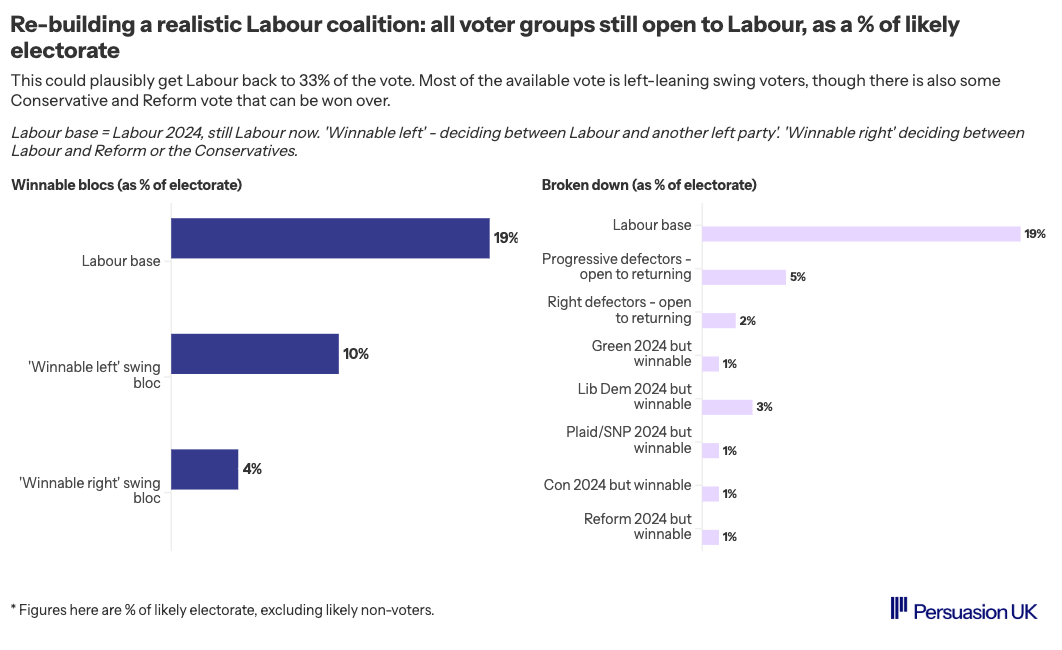
Once you do this, you find there is still – fittingly enough - about 33-35% of likely still voters open to Labour. On top of the base, this is comprised of 2024 defectors open to returning, plus some soft non-Labour voters from 2024 open to switching. You’ll note most swing voters are left-bloc swing voters (winnable left) but there’s some winnable right in there too. As we show in the report, this all holds across marginals too not just safer seats.
When you throw these voters into an RCT experiment where, among other things, you vary the Labour policy platform, you find that of 40-50 or so different policies of different flavours that we threw at them, the below turned out to be most salient:
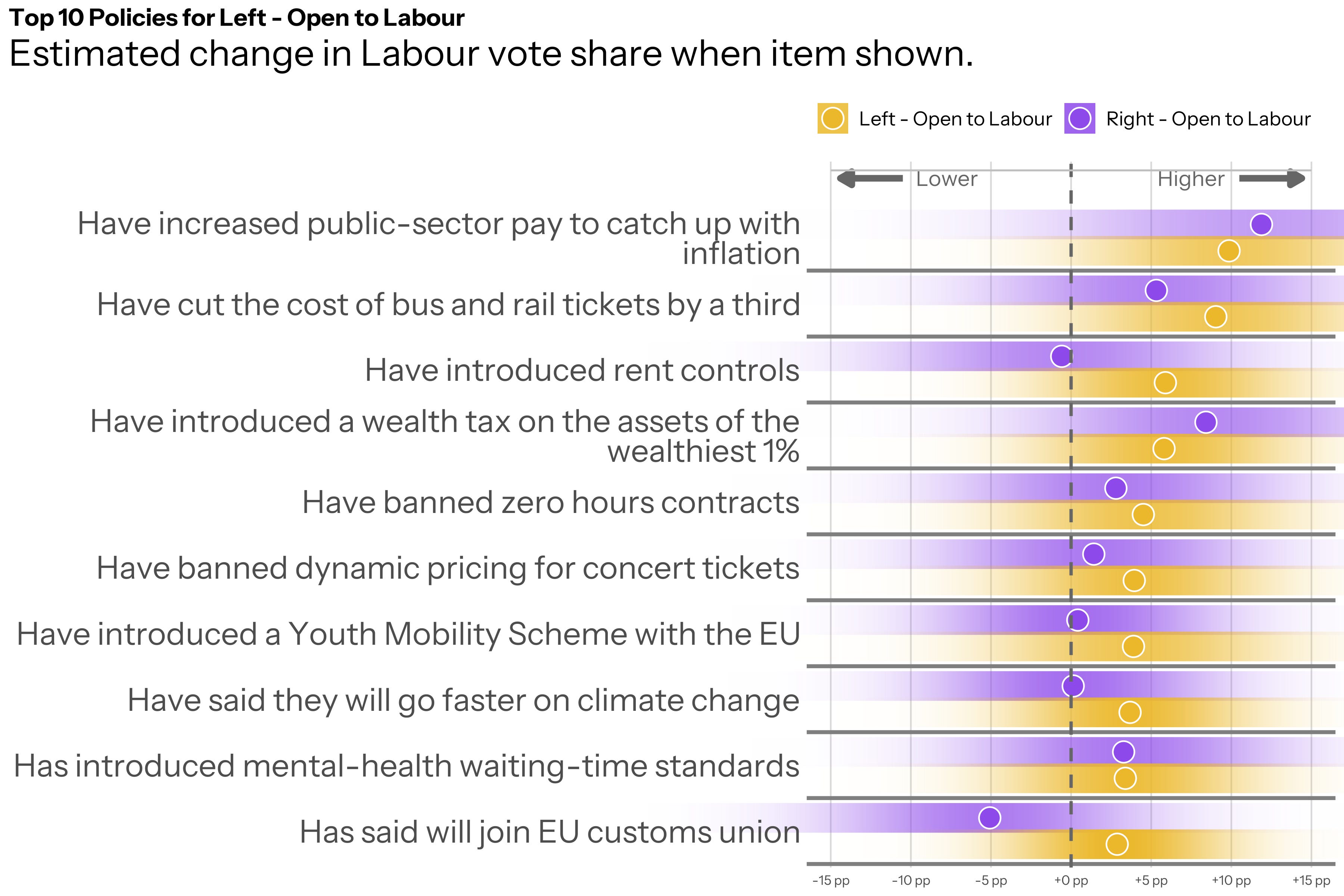
There’s definitely some ‘libby’ stuff here which works uniquely well with the left without alienating the right: closer ties to the EU, climate change (a subject the Greens have slightly oddly abandoned talking about), child poverty.
But what’s really notable is how vote moving a sort of cost-of-living populism is across the divide. As we’ve seen before in this kind of research, where cultural cleavages fracture modern left coalitions, requiring caution, populist economics has the potential to unite it.
This is fast becoming received wisdom across the US and UK left, as it happens. But it’s important because, done properly, it offers the opportunity for a unified moral story rather than micro-targeted offers or triangulation.
What doing it properly looks like is a whole other report, of course – but it almost certainly needs to go beyond the cold porridge of policy deliverism or retail policy alone (‘vote Labour and win a microwave’) and actively seek to embrace conflict and attention on these topics as wedge issues, to raise their salience and spotlight values divides with the right.
This is not impregnable as a theory, of course, there’s lots of ways it might be wrong - especially if you think the policy ideas in it are disasterous. But based on a pretty large body of research at this point, it’s my best guess at how you sustain modern social democratic coalitions.
What’s more certain is that if, as a theory, it’s not to Labour’s liking then they will need to find another one fairly quickly. They are already staring at a Biden-esque political obituary where their tenure is seen as a brief interregnum before a future owned by someone else.
*The full report is here. Thanks to 38 Degrees and Convergent Opinion for their partnership and support on everything.
Helpful in general, but I found the last graph confusing. Happily the main points were in the text, but I still couldn't work out the graph. (I usually love graphs, and my work involved them.)